ABOUT THE BOOK
America's Black Wall Street goes beyond the usual account of the 1921 Tulsa Race Massacre and the destruction of Black Wall Street. Amusan provides a historical and political context, a brilliant, yet overlooked explanation for this massacre and others across the United States. He takes us back to the Indian Territory, the settlement of the Five Civilized Tribes, the political and financial conflict between the tribes, their freedman, black resistance, and political strides.
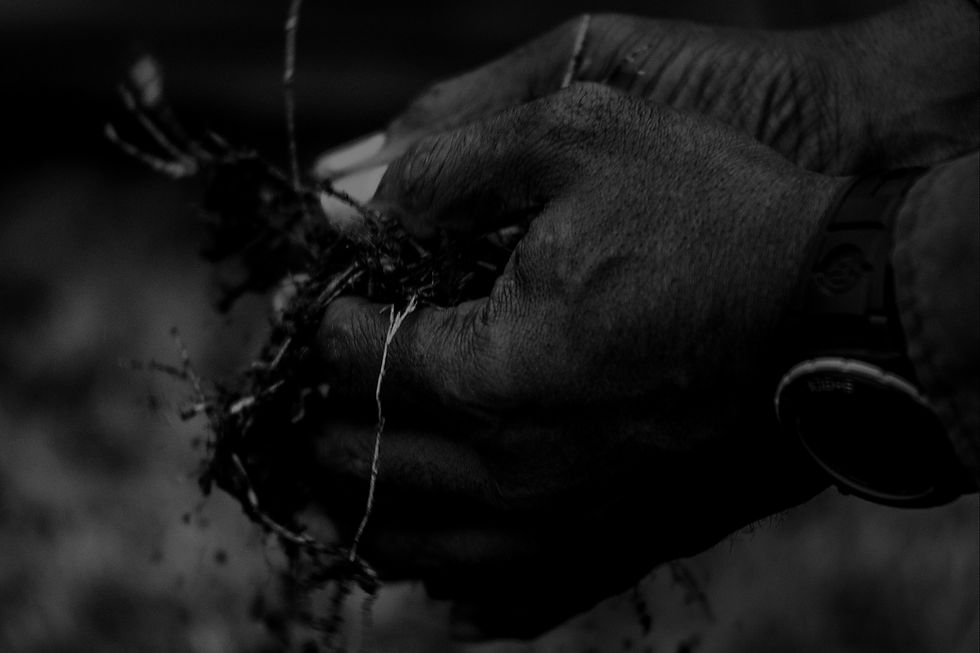
On the cover is a jar of soil I gathered with my own hands from sacred ground in Tulsa—the resting place of Ed Lockard, a victim of the 1921 Tulsa Race Massacre.
Inspired by Bryan Stevenson’s Equal Justice Initiative, this act is more than symbolic. It’s a ritual of remembrance—connecting land to legacy, pain to purpose. My hands around the jar represent a vow: to honor the lives lost and to never forget.
— Chief Egunwale Amusan
For Libraries, Bookstores & Classrooms
America’s Black Wall Street is available through Ingram for libraries, bookstores, and course adoption.
ISBN: 979-8-9892223-0-8
Ordering for a class or a library? Ask your bookstore or library vendor to order by ISBN through Ingram. For bulk orders, desk copies, or to book Chief Amusan as a speaker for your campus or institution, contact us.

ABOUT THE AUTHOR
Some people study history. Chief Egunwale Amusan lives inside it.
A lifelong Tulsan and descendant of three survivors of the 1921 Tulsa Race Massacre, Chief Amusan is an author, consultant, and one of the nation's most trusted History Recovery Specialists. He founded the Black Wall Street Memorial March Weekend and owns The Real Black Wall Street Tour, a family-run company recognized by the U.S. Department of State. Essence Magazine has profiled his work as a social entrepreneur.
His book, America's Black Wall Street, speaks for itself. History consultant Randy Hopkins of Portland State University calls it "a riveting book." Vivian Clark-Adams, Ph.D., a member of the original Oklahoma Commission to Study the Tulsa Race Riot of 1921, calls it "well-written and well-documented." Civil rights attorney Damario Solomon-Simmons calls it "courageous, passionate, and enlightening" and says it "may be the most significant read of the present time." U.S. Representative Christian Menefee of Texas's 18th District praises its "scholarly detail" and its demand for "present-day accountability." Filmmaker Tricia Woodgett calls it "truth-telling at its finest."
Chief Amusan testified before Congress in 2021 alongside the last three surviving massacre survivors, and his work helped inform the Department of Justice’s 2025 report. As President of the African Ancestral Society, he partners with the Terence Crutcher Foundation, Human Rights Watch, the ACLU, the Legal Defense and Educational Fund, and the Justice for Greenwood Foundation. He is a former member of the Tulsa Mass Graves Oversight Committee and the Center for Public Secrets board, and he serves on the board of the Tulsa Community Remembrance Coalition.
His expertise has shaped the Peabody Award-winning podcast series Blindspot, LeBron James’s Emmy Award-winning Dreamland, and Hulu FX’s The Lowdown, where he worked as a consultant. He executive produced Oaklawn, a documentary centered on the Tulsa mass graves investigation, and he directed and produced Up From the Earth Out Through the People.
Educators, take note. As a National Geographic 2892 Miles to Go storyteller, Chief Amusan created The Real Black Wall Street 2892 StoryMap, winner of the 2024 Esri Special Achievement in GIS Award. It has been used in virtual classroom curricula. He also served on the Preserve Route 66 Advisory Council.
Want a speaker who can cite the record, make it personal, and hold a room? Book Chief Amusan to speak at your next event.

REVIEWS & PRAISE

